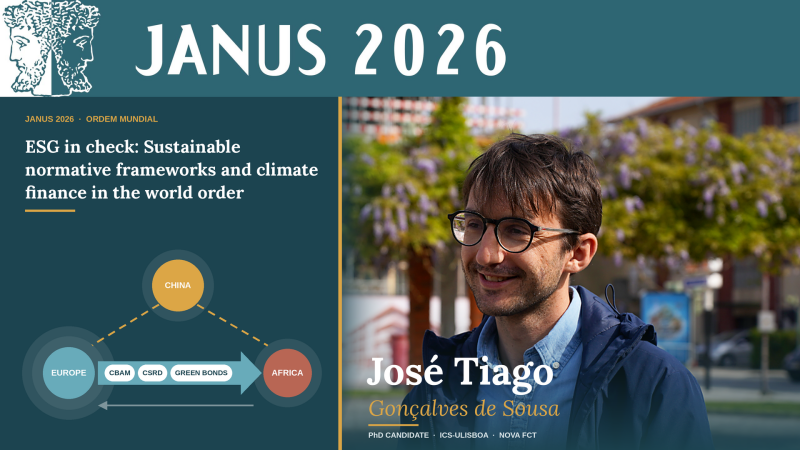
The publication of José Tiago de Sousa’s article “ESG in Check: Sustainable Normative Frameworks and Climate Finance in the World Order” in the 2026 edition of Janus marks a significant contribution to the debate on how Europe’s climate and sustainability rules shape the global economy. The article is now available through the journal’s DOI: https://doi.org/10.26619/2183-4822.2026.C119.
Sousa’s piece is not a conventional defence of ESG. It dissects the European architecture of sustainability regulation—from the Corporate Sustainability Reporting Directive (CSRD) and the Corporate Sustainability Due Diligence Directive (CSDDD) to the Taxonomy, the EU Emissions Trading System and the Carbon Border Adjustment Mechanism (CBAM)—and argues that the system is internally coherent but externally asymmetric. Europe, in his image, is the main animal pulling the cart; China is the second animal, pushing forward for both climate and industrial reasons; and African economies are left along the path, exposed to regulatory wheels they do not control.
The article examines the financial “reins” that move this cart: green bonds, sustainability-linked bonds and green sukuk. It notes that these instruments can channel capital toward decarbonisation, but also risk becoming compliance exercises or vehicles for greenwashing when verification remains concentrated in Europe and the United States. Sousa also explores China’s ambivalence—simultaneously the world’s largest emitter and largest producer of solar panels, batteries and electric vehicles—and shows how its lower carbon price and selective use of “ecological civilisation” complicate any simple convergence with European norms. For Africa, the article warns that CBAM and related rules may reduce the competitiveness of exports such as steel, aluminium and fertilisers, while African participation in ISO climate-related technical committees remains marginal.
One of the article’s most original contributions is its epistemic critique. Tiago questions the uncritical export of Ecological Modernisation Theory and argues that frameworks such as Andean Buen Vivir and African Ubuntu are not folklore but complete conceptual systems that change what is measured and who measures it. The European cart, he writes, was designed for European institutional soil; when its wheels meet other social terrains, they dig ruts. A wider cart, capable of accommodating different knowledge, may go further than a merely faster one.
José Tiago de Sousa is a Portuguese economist and researcher from Mindelo, Vila do Conde. He holds a degree in Economics and a Master’s in Finance from the Faculty of Economics of the University of Porto (FEP) and is currently pursuing a PhD in Climate Change and Sustainable Development Policies at NOVA FCT, in partnership with the Institute of Social Sciences of the University of Lisbon. His academic work is complemented by a strong record of civic engagement: he founded Solidarity Soul, an association supporting the elderly, vulnerable children and environmental causes, and has taken part in European Solidarity Corps missions in Italy, Poland and Turkey. In 2019 he received the University of Porto’s Active Citizenship Award in the Humanitarian/Solidarity category and has also been honoured twice with the U.Porto Volunteer Award—recognition that underlines the public dimension of his work. His Janus article confirms that his voice combines technical rigour with a clear concern for distributive justice and for the legitimacy of climate governance beyond Europe’s borders.
Add comment
Comments